Introduction
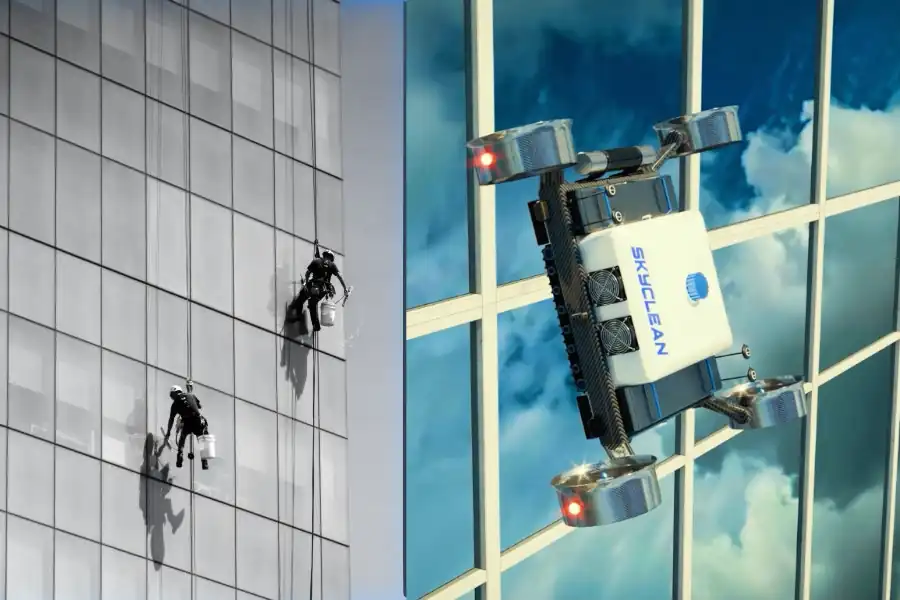
High-rise building façades and Agri-PV solar farms (where solar panels are placed above trees or bushes) are increasingly difficult and dangerous to clean using traditional methods. Manual window washing on skyscrapers is risky and slow, driving up insurance and labor costs. Meanwhile, dust and pollen on solar panels can slash energy output by 25% or more, meaning dirty panels directly translate to lost revenue for solar farm operators. These factors are fueling explosive demand for automated cleaning solutions – the global drone cleaning market is forecasted to grow from $4.36 billion in 2023 to over $13.2 billion by 2030.
Modern problems require modern tools. Autonomous drones and robots have emerged as a safer, faster way to maintain tall buildings and solar installations. Drones eliminate the need for workers to dangle off skyscrapers or tromp through remote solar fields, completing cleaning projects up to 10× faster than manual methods. This not only improves safety but also reduces downtime and costs. SkyCleanBot’s mission is to take this revolution a step further – leveraging intelligent aerial robotics to make façade and solar panel cleaning safer, faster, and more efficient than ever. Below, we examine three major challenges that conventional cleaning drones face, and how SkyCleanBot’s innovative design overcomes them.
Modern problems require modern tools. Autonomous drones and robots have emerged as a safer, faster way to maintain tall buildings and solar installations. Drones eliminate the need for workers to dangle off skyscrapers or tromp through remote solar fields, completing cleaning projects up to 10× faster than manual methods. This not only improves safety but also reduces downtime and costs. SkyCleanBot’s mission is to take this revolution a step further – leveraging intelligent aerial robotics to make façade and solar panel cleaning safer, faster, and more efficient than ever. Below, we examine three major challenges that conventional cleaning drones face, and how SkyCleanBot’s innovative design overcomes them.
Challenge #1: Maintaining Stable Contact on Vertical or Inclined Surfaces
Problem: Most drones struggle to operate in close proximity to walls or angled panels due to turbulent airflow and stability issues. The downwash from a drone’s rotors can recirculate against a wall and push the drone unpredictably, increasing the risk of collision. Tall buildings also channel winds and updrafts that make precise hovering extremely difficult. For this reason, current drone window cleaners usually keep a safe distance from the surface and rely on spraying water or detergent rather than physical scrubbing. While this non-contact approach avoids crashes, it has limitations – without direct contact, stubborn grime may not come off. It’s extremely challenging for a free-flying drone to apply consistent pressure for scrubbing or squeegeeing a surface. In short, traditional drones cannot “stick” to a wall, making precise cleaning pressure and coverage nearly impossible.
SkyCleanBot Solution: SkyCleanBot uses a hybrid drone and robot system that can actually attach itself to the surface being cleaned. Upon reaching a target façade or solar panel, SkyCleanBot engages a vacuum-powered suction mechanism to grip the surface securely. Essentially, it transforms from a flying drone into a wall-climbing robot on demand. Powerful fans create a negative-pressure zone between the device and the wall, allowing it to “stick” to vertical or inclined surfaces. Once attached, the drone’s rotors shut off and cleaning is performed using tracked drive modules that crawl along the surface like tank treads. This design provides rock-steady contact and lets SkyCleanBot exert uniform pressure for brushing or spraying. It eliminates the instability of free-hovering and ensures precise, consistent cleaning pressure at every point on the panel. Notably, wall-climbing cleaning robots have existed for years, but SkyCleanBot is among the first to combine aerial deployment with suction adhesion – bridging the gap between drone mobility and robotic stability. The result is a system that can autonomously fly to a high-rise window, latch on firmly, and scrub it clean just like a human would, without ever risking a human life.
SkyCleanBot’s concept is similar to hybrid solutions like the Helios system, which uses a drone to carry a tracked cleaning robot. Once in position, the robot uses suction and tracks to crawl over panels for thorough cleaning. SkyCleanBot integrates this capability into a single autonomous unit, allowing it to stick to surfaces and clean with stable, direct contact.
SkyCleanBot Solution: SkyCleanBot uses a hybrid drone and robot system that can actually attach itself to the surface being cleaned. Upon reaching a target façade or solar panel, SkyCleanBot engages a vacuum-powered suction mechanism to grip the surface securely. Essentially, it transforms from a flying drone into a wall-climbing robot on demand. Powerful fans create a negative-pressure zone between the device and the wall, allowing it to “stick” to vertical or inclined surfaces. Once attached, the drone’s rotors shut off and cleaning is performed using tracked drive modules that crawl along the surface like tank treads. This design provides rock-steady contact and lets SkyCleanBot exert uniform pressure for brushing or spraying. It eliminates the instability of free-hovering and ensures precise, consistent cleaning pressure at every point on the panel. Notably, wall-climbing cleaning robots have existed for years, but SkyCleanBot is among the first to combine aerial deployment with suction adhesion – bridging the gap between drone mobility and robotic stability. The result is a system that can autonomously fly to a high-rise window, latch on firmly, and scrub it clean just like a human would, without ever risking a human life.
SkyCleanBot’s concept is similar to hybrid solutions like the Helios system, which uses a drone to carry a tracked cleaning robot. Once in position, the robot uses suction and tracks to crawl over panels for thorough cleaning. SkyCleanBot integrates this capability into a single autonomous unit, allowing it to stick to surfaces and clean with stable, direct contact.
Challenge #2: Limited Flight Time and High Energy Consumption
Problem: Multirotor drones are notorious for short flight times – especially when carrying heavy payloads like water tanks or cleaning tools. Hovering in place while spraying or brushing consumes a lot of energy, meaning cleaning drones often exhaust their batteries in 15–30 minutes. For example, simply flying up to great heights and holding position can drain a drone’s battery very quickly, leaving little time for actual cleaning. Covering a large façade or solar array requires long, slow passes, which is the opposite of what drone flight is optimized for. Some drone systems attempt to address this by tethering to ground power, but dangling power cables introduce their own complications. The fundamental challenge is that a drone hovering uses continuous high thrust just to counter gravity, wasting energy that could otherwise go into cleaning tasks. The result is frequent battery swaps or recharges, and an inability to sustain long-duration cleaning operations.
SkyCleanBot Solution: SkyCleanBot’s approach dramatically extends operational time by minimizing free-flight hover time. As soon as it attaches to a surface (using the suction system described earlier), it can shut off its lift rotors entirely, reducing energy draw to a trickle. Instead of fighting gravity with propellers, SkyCleanBot effectively becomes a self-propelled crawler on the building or panel. Motors driving the tracks consume only a fraction of the power that four drone rotors do. This design yields an energy savings of up to 80% during cleaning operations (as the company’s internal tests have shown). In practical terms, SkyCleanBot can clean for far longer on a single charge than a hovering drone. There is precedent for improving endurance this way – for instance, some high-rise drones use hybrid tether systems to get virtually unlimited power. SkyCleanBot achieves a similar endurance boost untethered, by simply not expending energy on hover. The rotors are only active during transit between cleaning areas, then turned off when the surface mode is engaged. Thanks to this energy-efficient design, long-duration cleaning cycles are possible. SkyCleanBot can methodically crawl across a façade or row of panels for extended periods, completing jobs in one session that might take many flights for a conventional drone. This not only improves productivity but also reduces wear on the drone’s components (since continuous hover at max thrust strains batteries and motors). In short, by shutting off its rotors while cleaning, SkyCleanBot solves the flight-time bottleneck that limits other cleaning drones.
SkyCleanBot Solution: SkyCleanBot’s approach dramatically extends operational time by minimizing free-flight hover time. As soon as it attaches to a surface (using the suction system described earlier), it can shut off its lift rotors entirely, reducing energy draw to a trickle. Instead of fighting gravity with propellers, SkyCleanBot effectively becomes a self-propelled crawler on the building or panel. Motors driving the tracks consume only a fraction of the power that four drone rotors do. This design yields an energy savings of up to 80% during cleaning operations (as the company’s internal tests have shown). In practical terms, SkyCleanBot can clean for far longer on a single charge than a hovering drone. There is precedent for improving endurance this way – for instance, some high-rise drones use hybrid tether systems to get virtually unlimited power. SkyCleanBot achieves a similar endurance boost untethered, by simply not expending energy on hover. The rotors are only active during transit between cleaning areas, then turned off when the surface mode is engaged. Thanks to this energy-efficient design, long-duration cleaning cycles are possible. SkyCleanBot can methodically crawl across a façade or row of panels for extended periods, completing jobs in one session that might take many flights for a conventional drone. This not only improves productivity but also reduces wear on the drone’s components (since continuous hover at max thrust strains batteries and motors). In short, by shutting off its rotors while cleaning, SkyCleanBot solves the flight-time bottleneck that limits other cleaning drones.
Challenge #3: Water Supply to the DroneChallenge #2: Limited Flight Time and High Energy Consumption
Problem: Water is a double-edged sword for drone cleaners. On one hand, you need water (or cleaning solution) to wash away dirt; on the other, carrying or delivering that water is a huge challenge for airborne systems. Many existing drone façade cleaning systems use hoses tethered to ground-based pumps for water supply. While this provides continuous water and high pressure, it severely limits the drone’s range and agility. A long hose full of water is heavy and creates substantial drag. In fact, a hose can act like a “massive anchor,” making it hard for the drone to maneuver and causing it to sway or struggle in flight. Tethered drones also can’t venture far from the support truck or water source on the ground, which is impractical for remote solar farms or expansive buildings. Onboard tanks avoid the hose problem but introduce another issue – limited water capacity. A drone can only carry a few liters without overweighting itself, which traditionally would only clean a small section before running dry. Frequent refilling or short cleaning runs undermine the efficiency gains of using a drone at all. This trade-off has been a major barrier: hose-fed drones have water but are encumbered; tank-fed drones are nimble but quickly out of water.
Most drone cleaning systems today rely on tethered hoses for water supply (bottom), which add weight and aerodynamic drag. While effective for spraying water (top-left), hoses constrain the drone’s movement and stability. SkyCleanBot eliminates the hose by carrying its own water in an efficient onboard system.
SkyCleanBot Solution: SkyCleanBot is designed to be self-sufficient in water. The system carries an onboard water tank of 4 or 6 liters, carefully calibrated so that the added weight remains manageable. Thanks to SkyCleanBot’s efficient cleaning method, this volume is enough to wash a surprisingly large area – on the order of dozens of square meters per fill (exact coverage depends on dirtiness of the surface). How is this possible? The key is water efficiency. SkyCleanBot uses a method analogous to professional window washing, where very little water is wasted. Rather than indiscriminately power-washing and letting most water run off, SkyCleanBot performs a targeted, four-stage cleaning process for each section:
This approach mimics the manual cleaning technique a human would use with a sponge and squeegee, and it dramatically reduces water usage. In fact, modern drone cleaning systems have shown they can use up to 90% less water than traditional pressure washing. By scrubbing and reclaiming water in stages, SkyCleanBot wrings the maximum cleaning effect out of every drop. The 4-6 L onboard supply is sufficient to clean a broad section of façade or a significant number of solar panels before needing a refill. Importantly, no heavy hose is needed at all – the drone is free to fly and climb without dragging any tether. This opens up truly remote cleaning scenarios (like desert solar farms) that hose-reliant drones couldn’t handle. SkyCleanBot’s enclosed water system also means it can precisely control flow and even recycle or filter water on the fly if needed. By carrying its own water and using it frugally, SkyCleanBot enables high-performance cleaning that is both untethered and eco-friendly.
Most drone cleaning systems today rely on tethered hoses for water supply (bottom), which add weight and aerodynamic drag. While effective for spraying water (top-left), hoses constrain the drone’s movement and stability. SkyCleanBot eliminates the hose by carrying its own water in an efficient onboard system.
SkyCleanBot Solution: SkyCleanBot is designed to be self-sufficient in water. The system carries an onboard water tank of 4 or 6 liters, carefully calibrated so that the added weight remains manageable. Thanks to SkyCleanBot’s efficient cleaning method, this volume is enough to wash a surprisingly large area – on the order of dozens of square meters per fill (exact coverage depends on dirtiness of the surface). How is this possible? The key is water efficiency. SkyCleanBot uses a method analogous to professional window washing, where very little water is wasted. Rather than indiscriminately power-washing and letting most water run off, SkyCleanBot performs a targeted, four-stage cleaning process for each section:
- Step 1: Wetting – The surface is first misted or sprayed just enough to loosen dirt, using an economical fine spray instead of a continuous blast.
- Step 2: Brush Scrubbing – Integrated rotary brushes then agitate the grime, scrubbing the surface while using only minimal additional water.
- Step 3: Squeegee Removal – A built-in squeegee (or scraper) immediately wipes off the dirty water mixture. This prevents dirty runoff from just spreading the grime around.
- Step 4: Drying – Finally, powerful but compact fans dry the surface, leaving it clean and spot-free without streaks.
This approach mimics the manual cleaning technique a human would use with a sponge and squeegee, and it dramatically reduces water usage. In fact, modern drone cleaning systems have shown they can use up to 90% less water than traditional pressure washing. By scrubbing and reclaiming water in stages, SkyCleanBot wrings the maximum cleaning effect out of every drop. The 4-6 L onboard supply is sufficient to clean a broad section of façade or a significant number of solar panels before needing a refill. Importantly, no heavy hose is needed at all – the drone is free to fly and climb without dragging any tether. This opens up truly remote cleaning scenarios (like desert solar farms) that hose-reliant drones couldn’t handle. SkyCleanBot’s enclosed water system also means it can precisely control flow and even recycle or filter water on the fly if needed. By carrying its own water and using it frugally, SkyCleanBot enables high-performance cleaning that is both untethered and eco-friendly.
Conclusion
SkyCleanBot’s innovations directly tackle the biggest hurdles in drone-based cleaning. By achieving stable contact on vertical surfaces, extending operation time through energy-saving design, and becoming self-reliant in water supply, SkyCleanBot represents a new generation of autonomous cleaning drones. For facility managers, building owners, and solar farm operators, this technology promises to make maintenance safer, faster, and more cost-effective than ever before. Imagine cleaning your glass skyscraper without hanging scaffolds, or scrubbing a remote solar array without dispatching a crew – SkyCleanBot makes it possible.
Now is the time to get on board with this revolution in cleaning. SkyCleanBot is currently gearing up for deployment, and we are inviting early adopters to partner with us. Be among the first to experience the productivity gains and safety improvements of SkyCleanBot’s system. Contact us today for more details, demos, or to discuss an early purchase arrangement. As an early client, you’ll not only benefit from special pilot-program pricing but also help shape the future of automated cleaning technology. Don’t let your building maintenance fall behind – reach out to SkyCleanBot and join us in making cleaning smarter and safer for everyone.
SkyCleanBot – Cleaning Reimagined. Get in touch to learn how you can be one of our first proud clients and leave dangerous, inefficient cleaning methods in the past. Your facades and solar panels will thank you, and so will your bottom line.
Contact SkyCleanBot today to unlock a new era of maintenance excellence.
Now is the time to get on board with this revolution in cleaning. SkyCleanBot is currently gearing up for deployment, and we are inviting early adopters to partner with us. Be among the first to experience the productivity gains and safety improvements of SkyCleanBot’s system. Contact us today for more details, demos, or to discuss an early purchase arrangement. As an early client, you’ll not only benefit from special pilot-program pricing but also help shape the future of automated cleaning technology. Don’t let your building maintenance fall behind – reach out to SkyCleanBot and join us in making cleaning smarter and safer for everyone.
SkyCleanBot – Cleaning Reimagined. Get in touch to learn how you can be one of our first proud clients and leave dangerous, inefficient cleaning methods in the past. Your facades and solar panels will thank you, and so will your bottom line.
Contact SkyCleanBot today to unlock a new era of maintenance excellence.
Sources
- Drone Wash Blog – 2025 Growth in Drone Cleaning Sales: Trends to Watch
- ZJIEC – Drone Window Cleaner: The Safer, Faster Way to Maintain Skyscrapers
- IFBOT – How Autonomous Robots Transform Solar Panel Maintenance
- EAUAV – Drones for Window Cleaning, Facades & Solar Panels
- Hackster – AI Improves Drone Stability in Air Ducts
- KTV Working Drone – Company Statement
- New Atlas – Automated Solar-Panel-Cleaning System Doubles Down on Drones
- MDPI (Wang et al. 2025) – Design of a Modular Wall-Climbing Robot
- WillFlyDrone – How High Can a Window Washing Drone Actually Reach?
- EAUAV – Cleaning Drones FAQ
- PressureDr – Revolutionizing High-Rise Pressure Washing with Drones
- ZJIEC – Drone Solar Panel Cleaning: Ultimate Guide